
Story Genie - Personalized Children's Storybooks
Overview
Some of my most treasured memories are from reading bedtime stories to my daughter, watching her eyes light up as she imagined herself in those worlds. As she grew older, I found myself wishing the characters could have looked like her, lived in her world, and learned the same lessons we talked about at the dinner table.
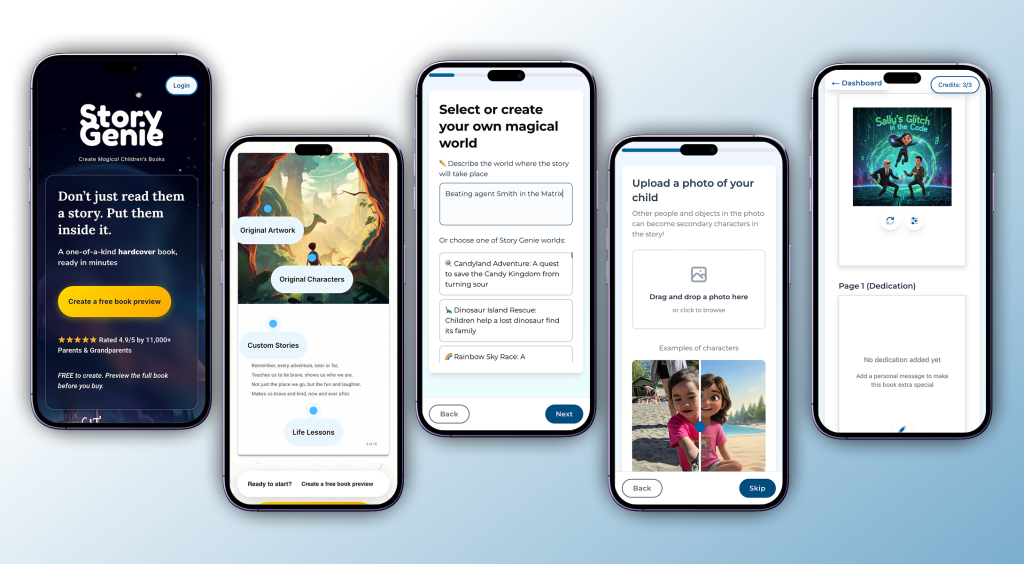
That wish became StoryGenie, a platform that turns a parent’s answers to a simple quiz into a fully personalized, AI-generated children’s storybook, illustrated and printed as a real book delivered to their door.
Role
Co-founder / CTO
Platform
Web
Deliverables
Product development, technical architecture, AI/LLM implementation, full-stack development, payment integration, print fulfillment, deployment.
Execution
Problem
Children’s books are wonderful, but they’re generic. Every kid reads the same story with the same characters. Parents who want something truly personal are left with expensive custom illustration services or clunky template-based tools that feel anything but magical.
Meanwhile, the explosion of generative AI has made it possible to create unique stories and illustrations on demand, but no one had packaged that capability into a seamless, end-to-end experience that a non-technical parent could use in minutes and hold in their hands as a real, printed book.
I wanted to build that experience, not as a novelty, but as something that could genuinely make reading time feel like a shared family adventure.
Onboarding
Early on, we noticed a significant drop-off at account creation. Parents would complete the quiz, hit a sign-up wall, and leave. After some discovery work and customer interviews, the reason became clear: we were asking for too much before giving anything back. The entire flow up to that point was take, take, take. Answer these questions, now create an account, now give us your email. The parent had invested effort but hadn’t seen a single thing in return.
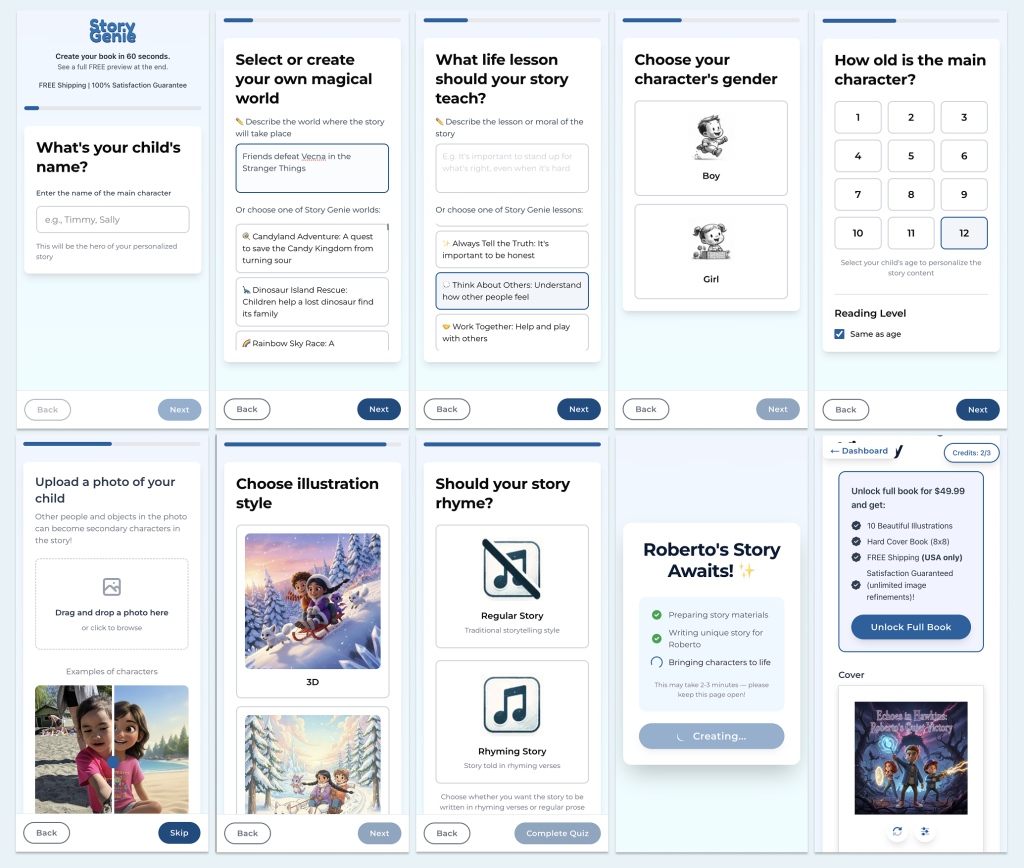
We flipped the experience. Now, parents start with a short, playful quiz. They answer 8-10 questions: pick a magical world, choose a life lesson, describe their child’s appearance, and decide whether they want a rhyming story. The quiz is designed to be fun in itself. It feels less like a form and more like the beginning of the adventure.
Once they finish, we immediately generate a preview: the book’s cover and first illustrated page, personalized to their child. This is the moment parents see their kid as the hero of a story that doesn’t exist anywhere else in the world. Only after they’ve experienced that do we ask them to create an account or make a purchase.
The shift was simple but powerful. By front-loading the value and showing parents what AI generation can actually do for their child before introducing any friction, we turned the biggest leak in our funnel into one of our strongest conversion points.
AI Story & Image Generation
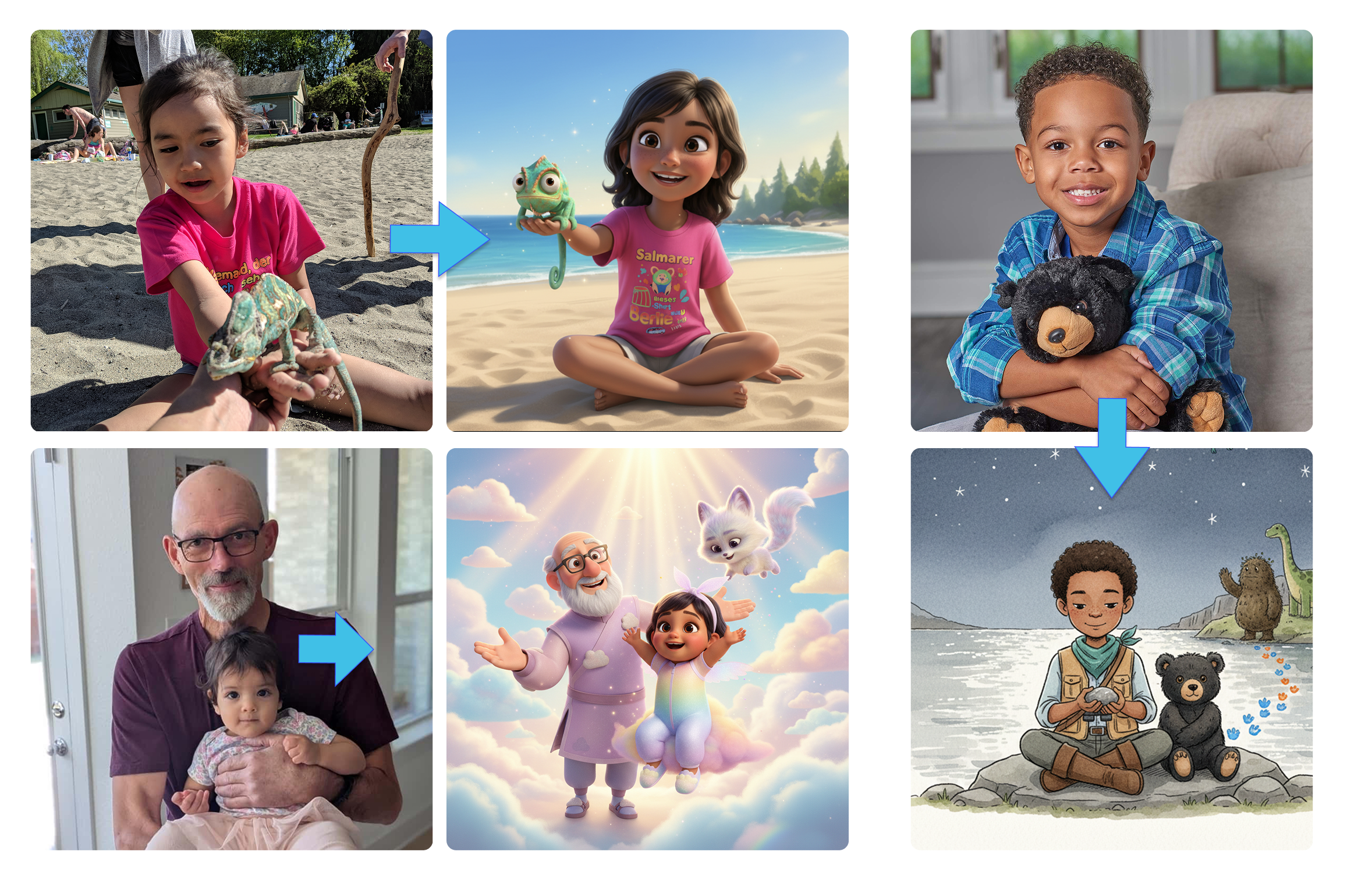
Under the hood, StoryGenie orchestrates multiple AI models to produce each book. OpenAI handles story generation, crafting age-appropriate narratives calibrated to reading levels from board-book simplicity for toddlers to chapter-style prose for older kids. Google’s Gemini model generates the illustrations in a warm, watercolor style.
The two biggest technical challenges were speed and character consistency.
Parents expect near-instant gratification after completing the quiz, but generating a full story plus multiple illustrations takes time. We solved this through an asynchronous generation pipeline. The preview renders quickly while the rest of the book generates in the background, with polling to keep the experience feeling responsive.
Character consistency was even harder. AI image models don’t inherently remember what a character looks like from one page to the next. A child with brown curly hair and green eyes on page one might appear blonde on page three. We invested significant effort into prompt architecture and character detail persistence to ensure the main character looks recognizably like the same kid across all ten pages. It’s one of those problems that sounds simple but required dozens of iterations to get right.
Business Model & Marketing Funnel
StoryGenie runs on a straightforward transactional model. Parents pay per book, with no subscription required. The freemium preview (cover + first page) lets them experience the product before purchasing, and paid users unlock all ten illustrated pages plus professional printing and shipping.
Our go-to-market strategy is B2C, focused on two pillars: targeted paid acquisition and organic referrals. The product has a natural viral loop. When a personalized book arrives at someone’s home, it gets shown to family, friends, and shared on social media. Grandparents order books for grandchildren. Parents gift them for birthdays. Each book becomes its own marketing moment.
On the paid side, my co-founder leads advertising across Meta and Google, with comprehensive analytics tracking through GTM, GA4, and Meta Pixel to attribute every sale back to its source. We’ve been methodical about optimizing our cost of acquisition, continuously refining targeting and creative based on what the data tells us.
Outcomes
StoryGenie launched in January 2026 and has since surpassed 1,000 books sold as of April 2026. Through continuous optimization of our acquisition funnel and the natural word-of-mouth that a physical, shareable product generates, we’ve reduced our customer acquisition cost by approximately 38% since launch.
The platform is live and growing, with my co-founder driving marketing and business operations while I continue building on the technical side, refining AI quality, expanding customization options, and improving the end-to-end experience from quiz to doorstep.
What started as a dad’s wish to make storytime more personal has become a product that hundreds of families use to create something they’ll keep on the bookshelf for years.